Former Florida gubernatorial candidate James Fishback announced this week that he will be running for president in 2028.
Collins finished second with approximately 25.1% in the crowded contest
Fishback previously entered Florida’s 2026 Republican gubernatorial primary in November 2025.
He presented himself as a conservative outsider focused on affordability and immigration.
The investment executive founded Azoria and established student debate nonprofit Incubate Debate.
His gubernatorial proposals included restricting corporate home purchases and restricting employment visas.
He also advocated eliminating property taxes and opposing data centers.
Those positions distinguished Fishback from other Republicans seeking to succeed term-limited Florida Gov. Ron DeSantis.
President Donald Trump endorsed Congressman Byron Donalds instead of Fishback. The Republican primary also featured Lieutenant Governor Jay Collins and Paul Renner.
Donalds won the August Republican primary with ease over Fishback and all of the other candidates.
Ballotpedia reports Fishback received 173,575 votes, representing approximately 10.4% of Republican primary ballots.
Donalds received 796,267 votes, or approximately 47.9%, in the primary.
Collins finished second with approximately 25.1% in the crowded contest.
Nevertheless, Fishback’s gubernatorial campaign website now describes the election as finished while promising another chapter.
WATCH:
Last night, someone asked me “What do you plan on doing next?”
— James Fishback (@jamesfishback) October 28, 2026
I told them the truth.
I’m running for president. pic.twitter.com/yRdxr9KdS2
__PRESVEND__
Republican voters have largely decided who they want to support for president in 2028, while a large plurality of Democrats remain undecided.
Vice President JD Vance has emerged as the early leader, while nearly half of Democratic primary voters remain undecided about who should represent their party after President Donald Trump leaves office, according to a new New York Times/Siena University poll.
The poll provides an early snapshot rather than a prediction…
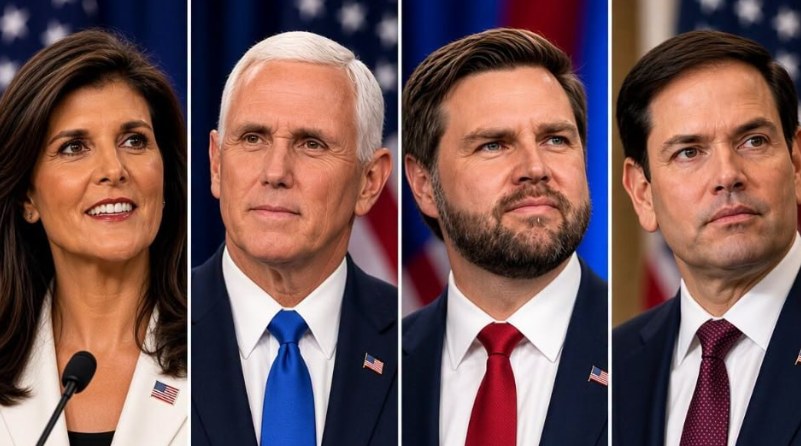
The survey found 33% of Republican primary voters choosing Vance as their preferred nominee, giving the vice president a 10-point advantage over Secretary of State Marco Rubio, who finished second with 23%.
The contrast on the Democratic side was striking, with 45% of Democratic primary voters saying they did not know whom they would support if their party’s presidential primary were held today.
Former Vice President Kamala Harris received 12%, making her the…
Former Vice President Kamala Harris received 12%, making her the most frequently named Democratic candidate, while California Gov. Gavin Newsom followed with 9%.
Former Transportation Secretary Pete Buttigieg received 7%, Rep. Alexandria Ocasio-Cortez of New York drew 6%, Georgia Sen. Jon Ossoff received 4%, and Arizona Sen.
Mark Kelly registered 3%.
Another 15% of Democratic respondents volunteered someone outside the listed field, further underscoring how unsettled the party’s potential 2028 contest remains more than two years before the first presidential primaries.
The Republican results showed considerably more consolidation around two figures closely associated with the Trump administration, as Vance and Rubio combined for support from 56% of GOP primary voters.
Trump himself received 8% when included as an option, despite the Constitution’s 22nd Amendment barring anyone from being elected president more than twice, while Florida Gov. Ron DeSantis received 3%.
Twenty-six percent of Republican respondents said they were undecided, a substantial number but still far below the 45% recorded among Democratic primary voters.
The poll provides an early snapshot rather than a prediction of the 2028 race, particularly because no major-party primary campaign is formally underway and the eventual fields could look substantially different by the time candidates begin announcing their campaigns.
Vance’s position nevertheless mirrors other national polling conducted during 2026, which has repeatedly placed the vice president at or near the top of potential Republican primary fields.
An October Focaldata survey conducted for the Financial Times, for example, showed Vance at 38% among likely Republican primary voters compared with 24% for Rubio, while DeSantis received 9% and Donald Trump Jr. drew 7%.
The New York Times/Siena results suggest Rubio currently represents Vance’s most significant potential competition among Republican voters, although both men remain members of the Trump administration and neither has formally entered the 2028 race.
Trump has repeatedly praised both Vance and Rubio when questioned about the Republican Party’s future, fueling speculation that the president’s eventual endorsement could become an important factor in determining his political successor.
The Democratic picture is considerably less settled, with the Times/Siena…
The Democratic picture is considerably less settled, with the Times/Siena survey producing notably weaker support for Harris than several other national polls conducted during the year.